
The New NDIS Laws: What is Changing and When
Australia has passed the biggest set of changes to the NDIS in years, and the first of them start today. If you are a participant, a family member or a nominee, the most important thing to know is that nothing is being switched off overnight. Your plan and your supports keep working as they are.
This article walks through what has actually changed, when the rest arrives, and what is worth doing now. Every point comes from official NDIS or Australian Government sources, listed at the bottom.
What has happened
Parliament passed the National Disability Insurance Scheme Amendment (Securing the NDIS for Future Generations) Bill 2026 on 19 August 2026. The Governor General signed it into law on 20 August 2026, and the first changes take effect from Thursday 27 August 2026.
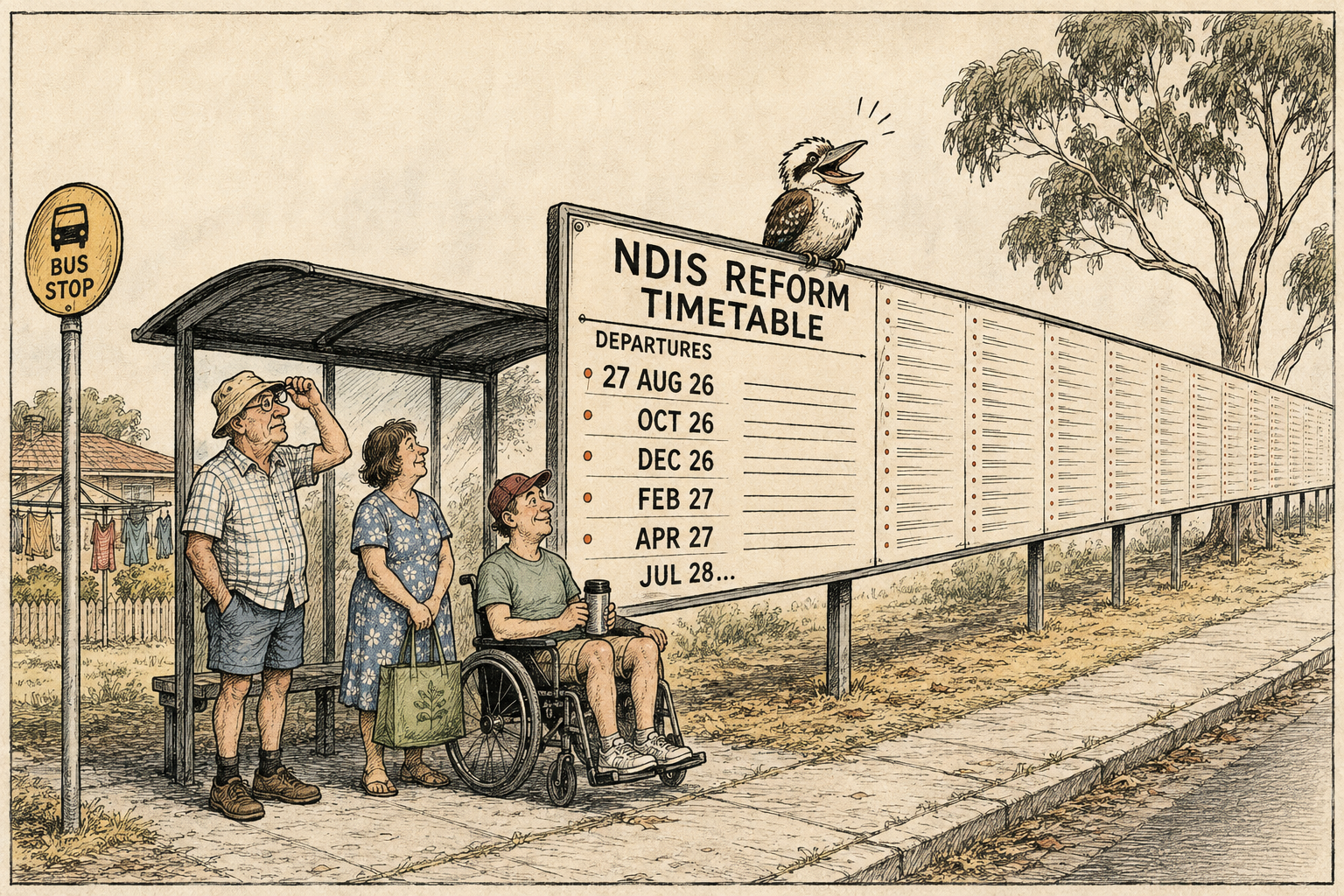
The reforms cover who can access the NDIS, how plans are managed, how funding is used, and how providers operate. They roll out in stages between now and 2028. The NDIA has said it will contact participants directly when a change affects them.
Changes that start today, 27 August 2026
Asking for a Plan Reassessment
If you want your plan reassessed before its scheduled date, the request now has to come from you, your plan nominee or your child representative. Support coordinators, providers and therapists can help you prepare the request, but they cannot lodge it on your behalf.
You can still ask for an early reassessment when there has been a significant and ongoing change to either of the following:
Your functional capacity and support needs;
Your living, education, work or informal support arrangements.
Plan variations have not changed. If you need a smaller adjustment, or something urgent, a variation is still the right pathway and is usually faster.
Keeping Records
There are now set periods for holding on to a record of supports and payments:
Participants - 3 years
Nominee - 5 years
Providers - 7 years
This matters most if you self-manage. If you cannot produce records showing your funding was used correctly, you may be asked to pay money back, Keeping invoices, receipts and service agreements in one folder, digital or paper, is enough.
Stronger compliance powers
The NDIA now has broader powers to request information and to act on suspected fraud or non-compliance. Participants and providers may be asked to provide information, and providers can face financial penalties for failing to do so. These obligations apply to registered and unregistered providers alike.
Pricing
The Minister for Disability and the NDIS now has the power to set maximum prices for NDIS supports, advised by the NDIA through the existing Annual Pricing Review. There is no immediate change to prices. The rates in the NDIS Pricing Schedule that started on 1 July 2026 continue to apply.
Automated Processing
Computer systems can now handle some routine administration, such as processing claims and payments. Decisions that are complex or that require judgement will still be made by people, and the NDIA must publish where automated systems are used.
From October 2026
Budget resets
Budgets for social, civic and community participation supports, and for capacity building daily activities, will be progressively reset. The Government has said this will reduce social, civic and community participation allocations by 50 per cent, and capacity building daily activity allocations by 10 per cent, bringing average spending in these categories back in line with 2023 levels.
Two points are worth being clear about.
This is applied progressively as each plan is reassessed or renewed, not to every plan on 1 October.
The Government has said the reset will not touch supports that are essential to critical care and daily living needs, such as in home supports, home and vehicle modifications and Specialist Disability Accommodation.
A new plan variation pathway is also being created for participants with high support needs who require continuous 24 hour care.
Plan Suspensions
The NDIA will be able to suspend a plan if a participant does not respond to a request for information. This is only after reasonable attempts to make contact, which the NDIA describes as at least five attempts over an extended period, to the participant, their nominee or their authorised representative. Keeping your contact details current with the NDIA is the simplest protection here.
From December 2026
Claims will need to be submitted within 90 days of a support being delivered. If you self manage, or if a provider is slow to invoice, this is the change to watch. Late invoices become a real problem rather than an annoyance.
From February 2027
Plan renewals replace plan continuations
When a plan is due for reassessment, it will either be reassessed by an NDIA planner or renewed with the same supports as the previous plan. Importantly, unspent funds from the previous plan will not carry over into the new one.
New reasonable and necessary criteria
The NDIA will apply new criteria when deciding what to fund in new participants’ plans, including clearer guidelines on what a parent is expected to provide for a child with disability. That covers supervision, personal care, transport, emotional support and behavioural support. It does not include the additional support a child needs because of their disability compared with children of a similar age. These criteria will be applied to existing participants progressively, at their next plan reassessment.
Further Ahead
April 2027: The NDIA begins introducing its new way of planning.
July 2027: Mandatory registration expands to providers delivering personal care and daily living supports, and supports provided in closed settings.
October 2027: A trusted panel of plan management providers is established. Participants will be supported to move to a provider on the panel over six months.
January 2028: Access changes begin for new applicants, using a standardised, evidence based assessment of functional capacity. Existing participants will be reassessed over three years.
July 2028: A new commissioned support coordination and connection function begins.
What should you do?
Most participants will not notice anything different this week. The changes that will be felt first are the tighter reassessment rules and, from October, the budget resets as plans come up for renewal.
Five things worth doing now:
Check your plan end date. If your plan is due for reassessment after October 2026, the reset is likely to apply to your next plan.
Look at your social and community participation spending. If there is a large unspent balance, understand why. If supports were not used because a provider was unavailable or a service did not suit you, that context matters at your next reassessment.
Get your evidence current. Reports from your occupational therapist, speech pathologist, psychologist or behaviour support practitioner should describe your day to day function, not just your diagnosis.
Tidy your records. Three years for participants, five for nominees. Start the habit now rather than reconstructing it later.
Confirm the NDIA has your correct contact details, and your nominee’s.
References
All sources accessed 27 August 2026.
NDIS, Securing the NDIS for future generations. https://www.ndis.gov.au/ndis-laws/securing-ndis-future-generations
NDIS, Legislation changes timeline for participants (PDF). https://www.ndis.gov.au/media/8800/download?attachment
Department of Health, Disability and Ageing, Securing the NDIS for future generations. https://www.health.gov.au/securingtheNDIS
Department of Health, Disability and Ageing, About the changes to the NDIS. https://www.health.gov.au/our-work/ndis-legislation-changes/amendments/ndis-amendment-securing-the-ndis-for-future-generations-bill-2026/about-the-changes-to-the-ndis
NDIS, What is a plan reassessment. https://www.ndis.gov.au/participants/changing-your-plan/types-plan-changes/what-plan-reassessment
NDIS, What is a plan variation. https://www.ndis.gov.au/participants/changing-your-plan/types-plan-changes/what-plan-variation
NDIS, What are the record keeping requirements. https://www.ndis.gov.au/providers/working-provider/reporting-and-recording-keeping/what-are-record-keeping-requirements
NDIS, New way of planning. https://www.ndis.gov.au/changes-ndis/new-way-planning
You Might Also Like



Parliament has passed the biggest changes to the NDIS in years, and the first of them started on 27 August 2026. Your plan keeps working, but the rules around reassessments, records and budgets are shifting between now and 2028. Here is a plain English guide to what changed, what is coming, and the five things worth doing before your next plan review.